|
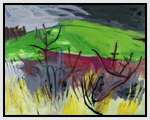 Throughout the twentieth century, artists in the vanguard have repeatedly challenged convention by exploring new avenues of expression and seeking alternative forms to embody new ideas. In the early years of the century, the so-called fauve artists ("wild beasts") in France, led by Henri Matisse, experimented with vivid, highly saturated colors and bold brushwork to evoke intense emotional responses. Later, artists such as the Russian Wassily Kandinsky carried these experiments further, creating abbreviated shapes that, however abstract, were meant to stand for specific concepts or forms. Throughout the twentieth century, artists in the vanguard have repeatedly challenged convention by exploring new avenues of expression and seeking alternative forms to embody new ideas. In the early years of the century, the so-called fauve artists ("wild beasts") in France, led by Henri Matisse, experimented with vivid, highly saturated colors and bold brushwork to evoke intense emotional responses. Later, artists such as the Russian Wassily Kandinsky carried these experiments further, creating abbreviated shapes that, however abstract, were meant to stand for specific concepts or forms.
Pablo Picasso and Georges Braque were responsible for one of the most radical innovations of the century. In their cubist paintings, these artists defied the long-held notion that painting provided a "window" into deep fictional space. Instead, they fractured forms and space into shifting planes and reduced their palette to a few muted tones. Yet Picasso never favored absolute abstraction as did Piet Mondrian, who eventually eliminated any reference to the natural world from the rigorous compositions of straight lines and primary colors that he intended as the expression of an ideal and universal order.
Surrealist artists, through a variety of styles and media, sought to exploit the internal world of imaginings and the unconscious. René Magritte, for example, employed precise illusionism to subvert expectations about reality. Others, including Joan Miró, employed the technique of automatism, making doodles or random marks on paper or canvas to trigger associations in the viewer's imagination. European surrealists provided a critical example for postwar American artists such as David Smith and Jackson Pollock. In his welded metal sculpture Smith incorporated "found" objects that, as a kind of sculptural equivalent to automatism, were often arranged to evoke the standing figure.
Pollock recorded his ideas and gestures on the canvas in dense webs of poured paint. Like his fellow abstract expressionists Barnett Newman and Mark Rothko, Pollock believed that abstraction would achieve all the expressive potential of representational art. By the 1960s, Pop artists Andy Warhol and Roy Lichtenstein were exploring alternatives to abstract expressionism with subjects drawn from popular culture and a style informed by mass mechanical reproduction.
source: here
|


 Dyscario Feed